
YouTube Now Auto-Labels AI Content. Every Marketer Should Read This
YouTube Now Auto-Labels AI Content. Every Marketer Should Read This.
YouTube started automatically detecting and labelling undisclosed AI-generated content in May 2026. On a platform generating $40.4 billion in annual ad revenue and reaching 2.7 billion users monthly, this is not a creator policy note. It is a shift in the rules of video marketing itself.
Most coverage of YouTube's new automatic AI labelling system has been written for individual creators. That framing misses the bigger picture. The brands running pre-roll ads, the marketing agencies producing video content at scale, the SEOs building YouTube as an owned traffic channel, and the businesses investing in Shorts as a discovery tool are all operating on a platform that just changed how viewers evaluate what they are watching.
That deserves a different conversation. Here is what the update actually says, what the verified data shows, and what it means for anyone with a video marketing strategy that runs through YouTube.
What YouTube Actually Changed: The Facts
On May 27, 2026, YouTube published a blog post confirming two connected updates to how AI content is handled on the platform.[1] Both were corroborated by YouTube Creator Liaison Rene Ritchie in an accompanying announcement video.
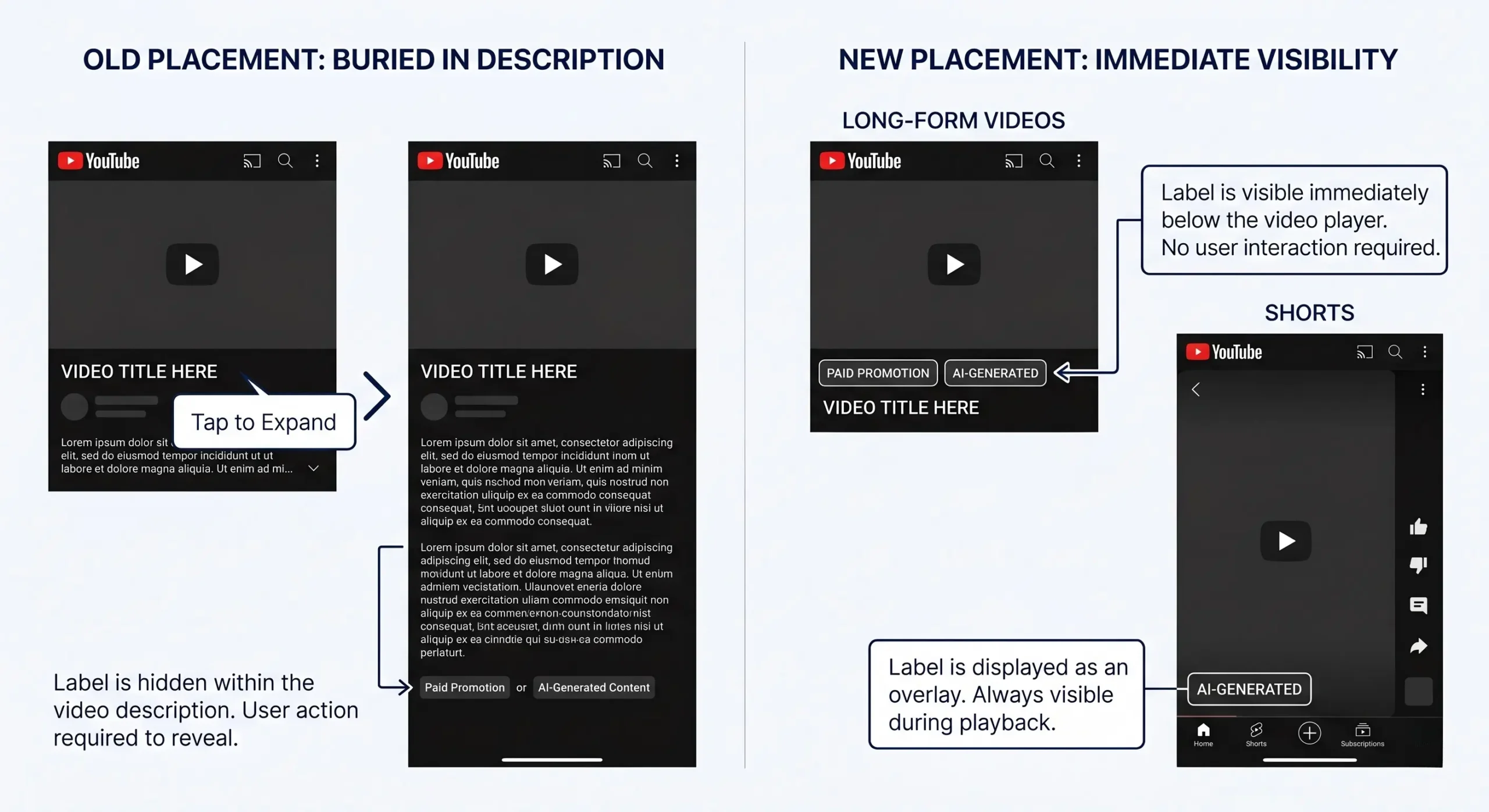
The first change concerns label placement. AI disclosure labels are now shown in positions viewers see without any extra action. For long-form videos, the label appears directly below the video player and above the description. For Shorts, it appears as an overlay on the video itself. Previously, these labels were placed inside the description panel, requiring viewers to expand it manually. Under the previous system, labels only appeared on the player for content covering sensitive topics such as health, news, elections, or finance. That restriction no longer applies.
The second change is more significant. YouTube is no longer relying on creators to self-disclose AI use. Starting May 2026, YouTube's internal detection systems will automatically apply an AI label when they identify significant photorealistic AI content in a video that has not been disclosed. Creators can dispute incorrect labels in YouTube Studio, but labels applied to content made with YouTube's own tools, Veo and Dream Screen, and content containing C2PA metadata confirming full AI generation, are permanent and cannot be removed.[1]
Why This Is a Marketing and SEO Issue
YouTube generated $40.4 billion in advertising revenue in 2025, exceeding the combined ad sales of Disney, NBCUniversal, Paramount, and Warner Bros. Discovery.[2] When total revenue including subscriptions is counted, YouTube crossed $60 billion, making it the largest media company by revenue outside of Disney.[3] With 2.70 billion monthly active users and 54 percent of marketers using the platform for advertising, any update to how content credibility signals appear here is not a niche policy change.[4][6]
YouTube's recommendation algorithm does not penalise AI-labelled content directly. Properly disclosed AI content receives normal algorithmic distribution, a position YouTube confirmed in its May 2026 announcement and consistent with 2026 algorithm analyses from OutlierKit and SocialPilot.[7] But the algorithm is satisfaction-weighted, meaning it responds to viewer behaviour after watching: whether they stay on the platform, replay, or leave quickly.
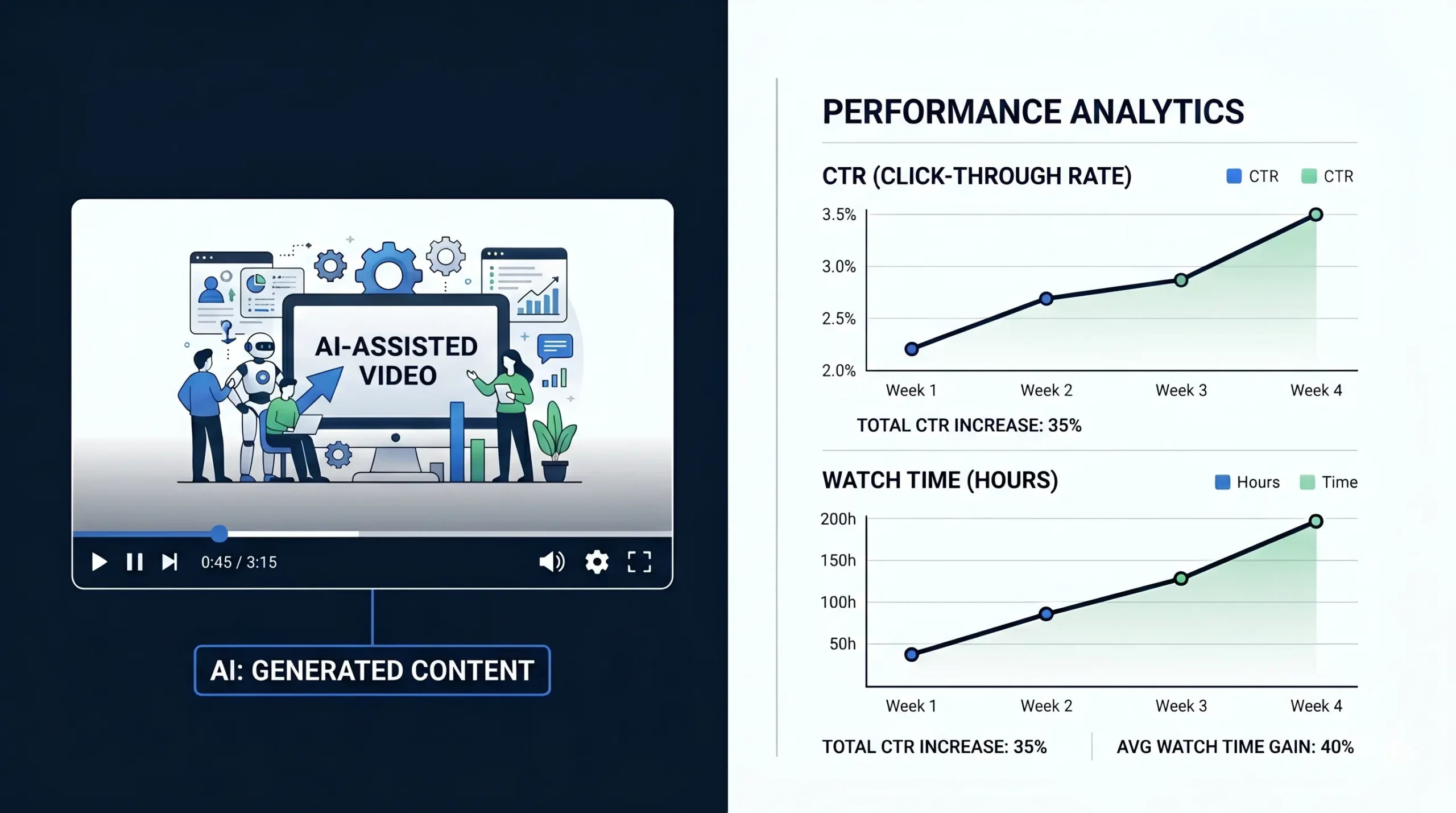
If a viewer sees an AI label and chooses not to click, or clicks and leaves quickly because the content felt less credible than expected, those behavioural signals feed directly into the recommendation engine. The label carries no direct algorithm penalty. The viewer's reaction to it does. And the average YouTube click-through rate sits between 4 and 6 percent, with strong videos reaching above 7 percent.[8] Even marginal shifts in CTR driven by label visibility have compounding effects on reach and distribution.
The Scale of AI on YouTube Right Now
One in five Shorts shown to new users is AI-generated, and over one million channels were using YouTube's own AI production tools daily before this update went live.[9][10] The automatic labelling system is not being built for edge cases. It is responding to the mainstream state of YouTube content in 2026.
How the YouTube Algorithm Treats AI-Labelled Content in 2026
Label Placement: Before and After
What to Do About It
For Brands and Marketing Teams
- Audit every AI-assisted video asset currently active in your library. If photorealistic AI was used and not disclosed, YouTube's detection may apply a label automatically. Self-disclosing before that happens is cleaner from a brand trust perspective than being labelled without any action on your part.
- Separate your content by audience trust requirement. Product testimonials, case study videos, and brand story content are high-trust formats where an AI label carries more viewer scrutiny. Awareness-stage content and entertainment-led Shorts carry less risk from a label perspective.
- Monitor CTR and average view duration on any AI-labelled videos over the next two quarters specifically. YouTube's algorithm will show you whether your audience is responding differently to labelled content before you need to make strategic decisions based on assumption.
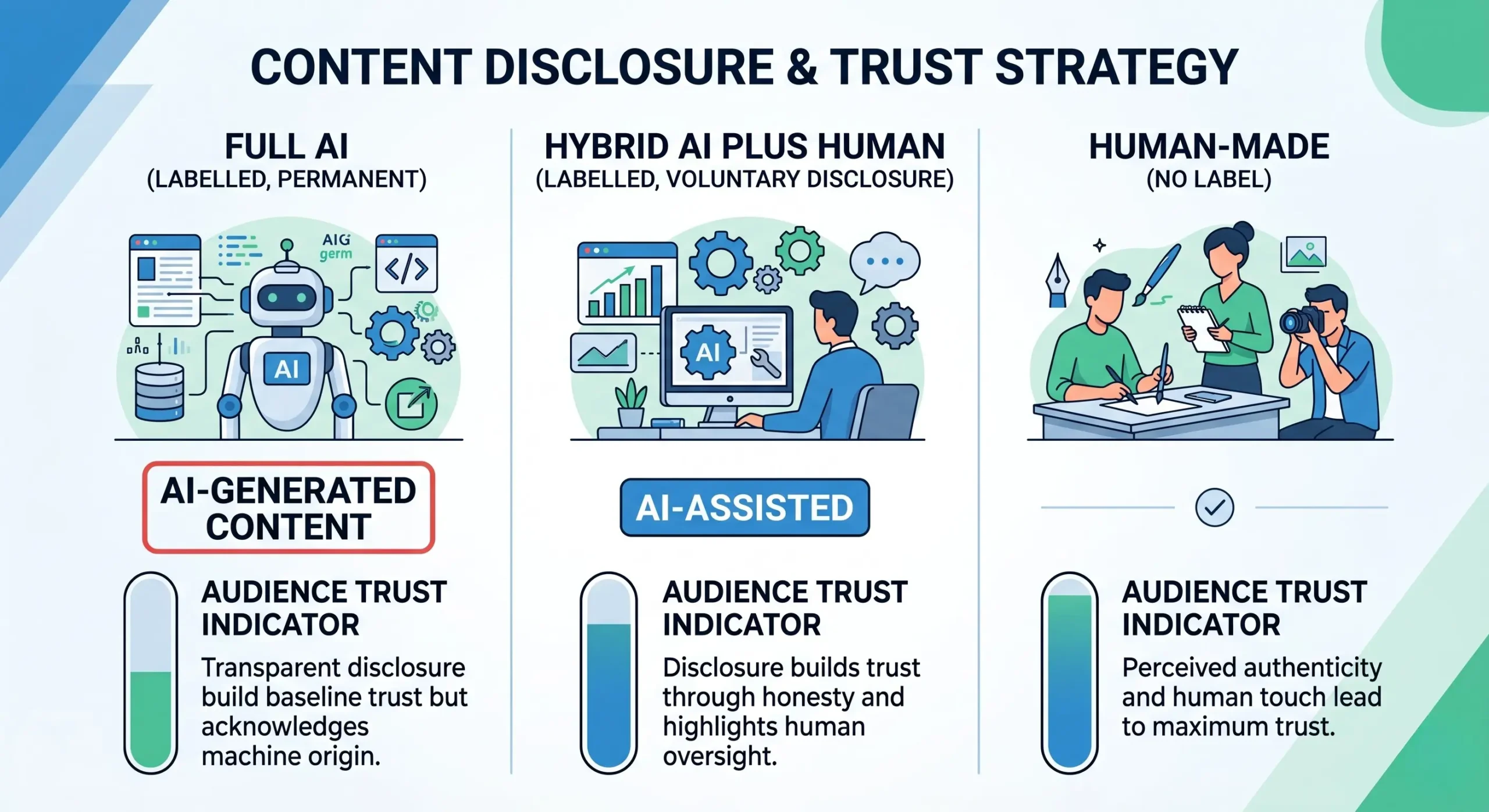
- Consider a hybrid production model: use AI for research, scripting, and editing efficiency, but keep the human-facing elements of your video, such as voiceover, on-camera talent, and filming, as human-made. This avoids the photorealistic AI detection trigger and keeps authenticity at the viewer touchpoint.
For YouTube SEOs and Channel Managers
- YouTube SEO now includes Gemini-powered multimodal analysis of the video itself, not just its metadata. Titles, descriptions, and tags still matter, but the algorithm reads tone, visual elements, and semantic meaning from the video content directly. Keyword-stuffed titles perform worse than specific, viewer-focused framing in 2026.[8]
- The shift to satisfaction-weighted discovery means optimising for completion rate and return visits is now more valuable than optimising for view count alone. A shorter video with 90 percent retention outperforms a longer video with 40 percent retention in the current recommendation model.[7]
- For Shorts specifically: the recommendation engine is fully decoupled from long-form. Swipe-through rate and loop rate within the first few seconds are primary ranking signals.[5] An AI label appearing as an overlay may affect swipe behaviour at scale given the 200 billion daily Shorts view volume.
- Track your YouTube channel's performance in Google Search as well as on-platform. YouTube content ranks in Google's video carousel and surfaces in AI Overviews. A credibility signal shift on YouTube can have downstream effects on branded and non-branded video search visibility.
The Bigger Picture: Trust as a Distribution Signal
YouTube's advertising business is built on audience trust in the content surrounding the ads. When viewers trust what they watch, they engage with it. When they engage, the algorithm amplifies reach. When reach grows, ad performance follows. That chain is what makes YouTube's $40.4 billion advertising business function.[2]
AI labels introduce a visible layer of context into that trust chain. They do not break it automatically. But they do change the information a viewer has before deciding whether to watch. On a platform where the algorithm responds to that decision at scale, across billions of signals daily, even small shifts in viewer behaviour by audience segment compound into meaningful performance differences over time.
YouTube is not running a campaign against AI-generated video. The platform sells its own AI production tools, Veo and Dream Screen, and has confirmed they do not penalise labelled content in recommendations. What YouTube is doing is ensuring that when viewers watch AI content, they know it. The label is for the audience, not a punishment for the creator or the brand.
But context changes behaviour. And behaviour drives the algorithm. That is the chain of cause and effect every marketer and SEO operating on YouTube needs to factor into their strategy from this point forward.
- YouTube Team. "Improving AI labels for viewers and creators." YouTube Official Blog, May 27, 2026. blog.youtube
- MoffettNathanson, as reported by Newsweek. "YouTube Just Hit Major Milestone That Has Hollywood Rattled." March 12, 2026. newsweek.com
- Variety. "YouTube Revenue for Full-Year 2025 Topped $60 Billion, Making Video Platform Bigger Than Netflix." February 4, 2026. variety.com
- Global Media Insight. "YouTube Statistics 2026: Users by Country and Demographics." May 2026. globalmediainsight.com
- OutlierKit. "YouTube Algorithm Updates 2026: Every Confirmed Change Explained." May 2026. outlierkit.com
- Vidico. "50 YouTube Marketing Statistics and Data to Know in 2026." March 2026. vidico.com
- SocialPilot. "YouTube Algorithm 2026: How It Works and Optimization Tips." May 2026. socialpilot.co
- DataSlayer. "YouTube Algorithm 2026: 7 Ways to Get Recommended." April 2026. dataslayer.ai
- Southern, Matt G. "YouTube Now Auto-Detects AI Content, Labels It For Viewers." Search Engine Journal, May 27, 2026. searchenginejournal.com
- Revenue Memo. "YouTube Marketing Statistics for 2026: A Comprehensive Analysis." May 2026. revenuememo.com