

Where did your customers go? (Aug 2026)
Where did your customers go? (Aug 2026)
Every client conversation about traffic drops eventually lands on the same question: is it AI Overviews? For most of the past two years the honest answer was "probably, but I can't prove it." That changed this year with the first properly controlled study on the question. Here's what it found, why Google's own reporting still won't answer this for you, and the diagnostic approach and framework I actually use.
For a long time, every claim about AI Overviews eating organic clicks rested on the same weak foundation: comparing traffic before and after the feature rolled out, or comparing queries that trigger it against similar ones that don't. Both approaches leave a real gap. Something else could have moved at the same time, a core update, a seasonal shift, a competitor's new page. Correlation isn't causation, and everyone quoting these numbers knew it.
That gap closed this year. I want to walk through the study that actually closed it, where Google's own Search Console still falls short of answering this for your specific site, and the process and framework I use with clients when a traffic drop lands on my desk.
The Study That Finally Proved It
In April 2026, researchers Saharsh Agarwal of the Indian School of Business and Ananya Sen of Carnegie Mellon University's Heinz College posted a working paper to SSRN titled "Google AI Overviews and Publisher Traffic: Evidence from a Field Experiment."[1] What makes it different from everything before it is the method. Instead of observing traffic patterns, they built a custom Chrome extension and randomly assigned 1,065 US participants, recruited through the research platform Prolific, into three groups: a control group that saw Google Search normally, a group whose extension silently removed AI Overviews from the results page in real time, and a group redirected into Google's AI Mode for every search.[1]
That randomization is what lets the authors claim something stronger than correlation. Because who saw an AI Overview and who didn't was decided by a coin flip, not by which topic they searched or when, any difference in behavior between the groups can reasonably be attributed to the AI Overview itself.
Two more details from the paper are worth knowing. Clicks on paid, sponsored results were unaffected, the drop was concentrated entirely in organic results.[1] And self-reported user satisfaction barely moved between the group that saw AI Overviews and the group that didn't, undercutting the argument that the feature is simply making search better for everyone at the cost of a click nobody wanted anyway.
It's also not the first number pointing this direction, just the most rigorous. Ahrefs' own analysis of Search Console data across 300,000 keywords found click-through rate on the top-ranking organic result dropped 58 percent when an AI Overview appeared, nearly double the 34.5 percent drop the same methodology measured a year earlier.[2] Different method, different exact number, same direction, and that consistency across two very different approaches is part of why I take the underlying finding seriously.
Why Google's Own Report Won't Answer This For You
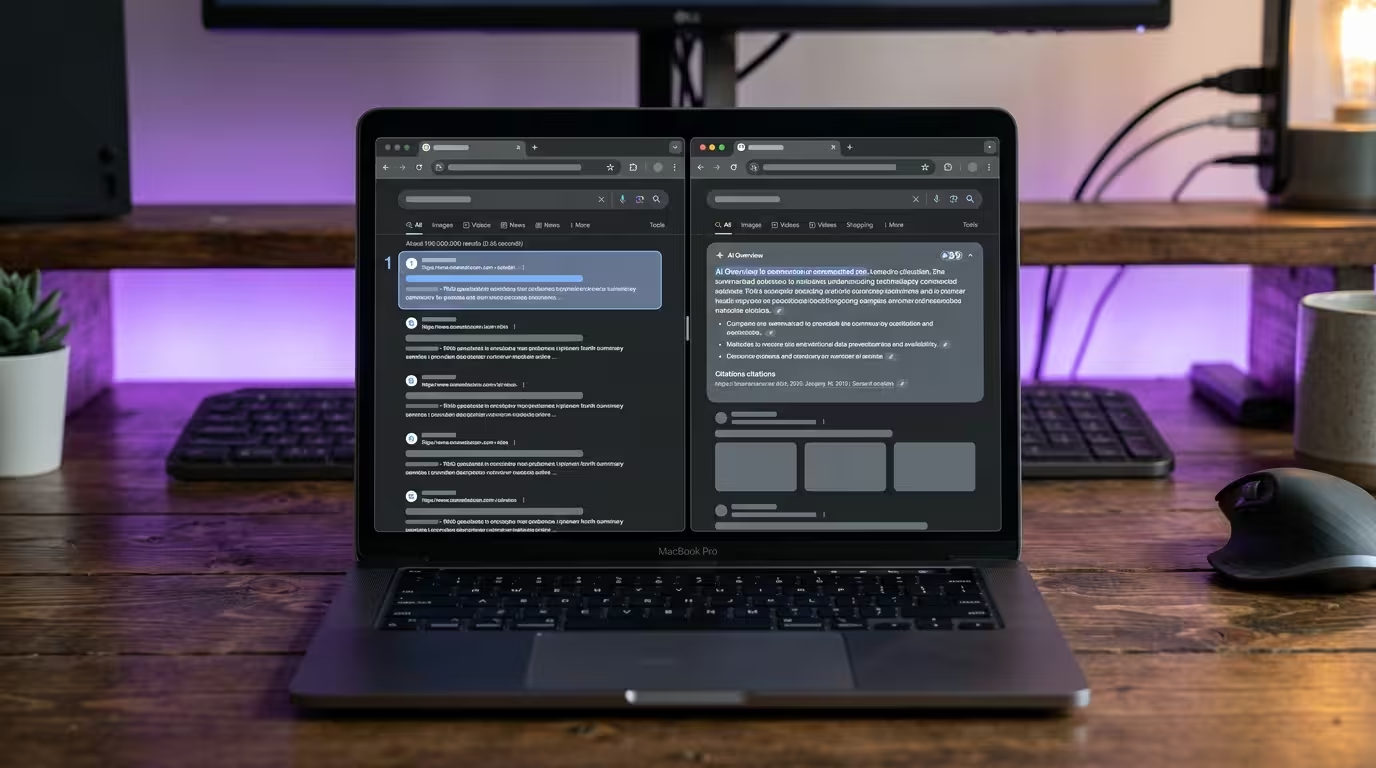
In June 2026, Google added a Generative AI performance report directly inside Search Console, breaking out impressions from AI Overviews and AI Mode separately from ordinary web results for the first time.[3] It's a genuinely useful addition, and if you haven't checked it yet, it's worth a look.
What it doesn't give you is the specific thing you actually need here: click data. The report shows impressions, not clicks, not click-through rate, and not query-level detail you can cross-reference against your ranking history.[3] You can see that your content showed up inside an AI Overview. You still can't see, from that report alone, whether showing up there cost you the click you used to get from ranking normally.
How I'd Actually Diagnose This
Since neither the academic study nor Google's native report gives you a site-specific answer, the diagnosis has to happen manually, inside your own Search Console data. Here's the process I run.
My Framework for Deciding What to Do About It
Once I've confirmed genuine click loss on a set of keywords, I sort them along two questions rather than one: does this query still make commercial sense to fight for, and does the AI Overview on it still link out to sources at all. That gives four honest categories, not a single "fix everything" response.
The two questions matter more than the four labels. "Is this still commercially worth fighting for" and "does the AI Overview still send anyone anywhere" together tell you whether to invest, adapt, or walk away, and they hold up regardless of which platform's AI answer you're looking at, not just Google's.
This is also where GEO work and traditional SEO genuinely diverge. Ranking well and being the citation an AI Overview actually references are related but separate goals, and a keyword can win at one while losing at the other.
- Agarwal, Saharsh and Sen, Ananya. "Google AI Overviews and Publisher Traffic: Evidence from a Field Experiment." SSRN Working Paper, posted April 3, 2026. papers.ssrn.com
- Ahrefs. "Update: AI Overviews Reduce Clicks by 58%." February 4, 2026. ahrefs.com
- Google Search Central. "Introducing Search Generative AI performance reports in Search Console." Google Search Central Blog, June 3, 2026. developers.google.com