
The Google May 2026 Core Update Hit Hard. Here Is What the Data Actually Says.
The Google May 2026 Core Update Hit Hard. Here Is What the Data Actually Says.
The tools are spiking. The community is louder than it was in March. But most of what is circulating right now is interpretation dressed as analysis. Here is the confirmed picture, the real patterns, and what you should actually do about it.
Google pushed the May 2026 core update live on Thursday May 21 at 08:40 PDT. It went up on the Search Status Dashboard under the standard classification: an incident affecting Ranking. No technical disclosure. No companion post. No named targets. That is how every broad core update starts, and by itself it tells us nothing except that the clock is running.
What the clock revealed over the following days is a different story. By the weekend, ranking movement was visible across verticals and countries. By Day 5, volatility sensors across more than twelve independent tracking tools were showing sustained, elevated readings. The SEO community reaction was not the usual background murmur. This one felt different, and the data backs that up.
What the Numbers Tell Us
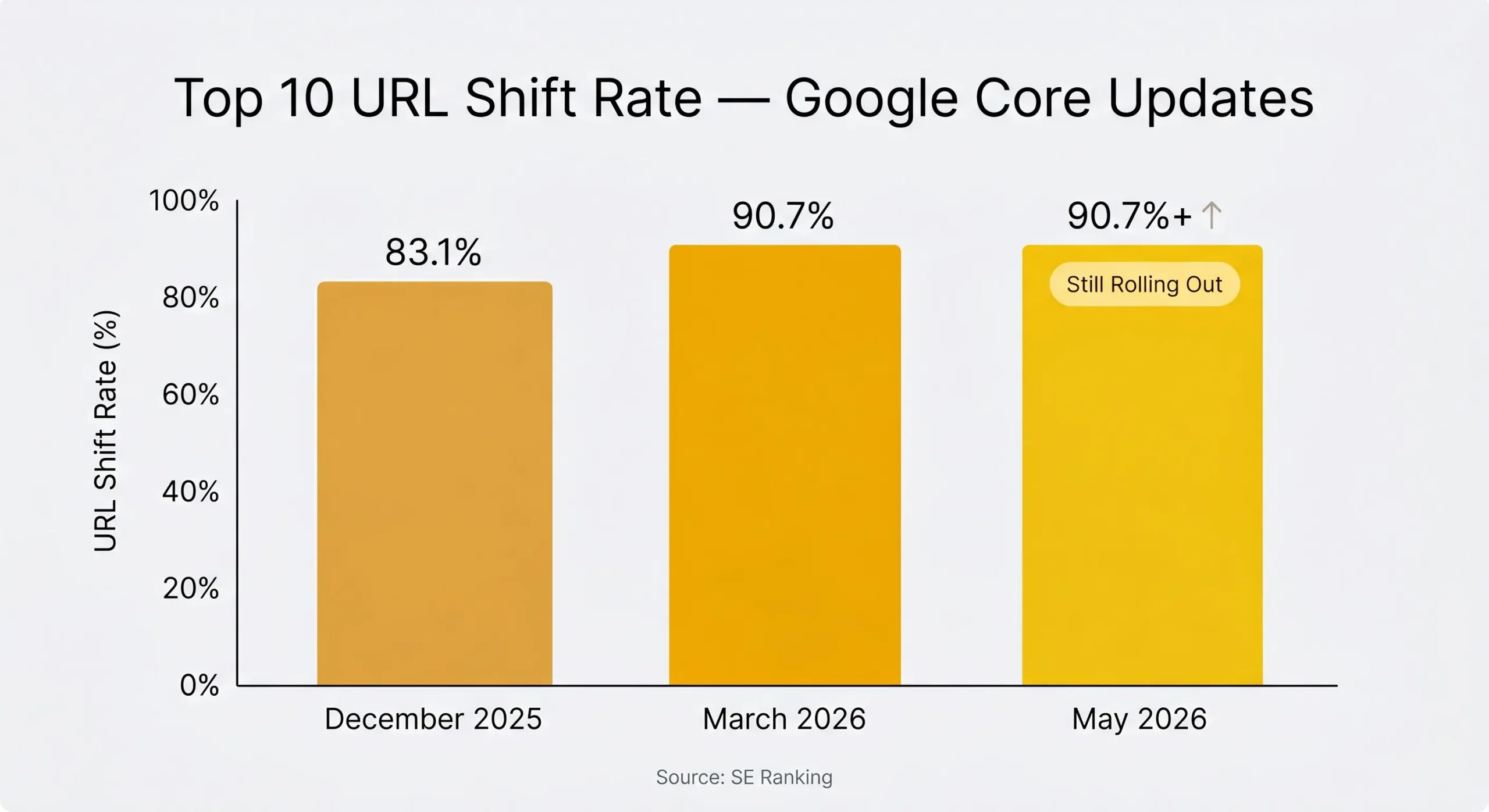
The March 2026 update is the clearest benchmark available. SE Ranking data from that rollout showed 79.5 percent of URLs in top-three positions changed, up from 66.8 percent in December 2025. In the top 10, 90.7 percent of URLs shifted, compared to 83.1 percent in December. Only 20.5 percent of top-three URLs held their exact position throughout the entire March cycle.[1]
May is trending beyond those numbers. Semrush Sensor, Mozcast, Accuranker, Sistrix, Algoroo, and multiple other tools all showed elevated readings that climbed through the first week. The March rollout peaked at 9.5 out of 10 on the Semrush Sensor mid-rollout. Day 3 calibration for May was already projecting a comparable or higher ceiling based on the trajectory of the opening 72 hours.[2]
Where the Impact Is Landing
Google has not named any targets. That is always the case. But consistent patterns are emerging from multi-client portfolio tracking and community data across the first week.
Why May Feels Heavier Than March
Two things stand out when comparing this rollout to March. The first is the 43-day gap between updates. That is the tightest inter-update cadence outside Penguin-era refresh cycles.[2] For any site that took a hit in March and spent April trying to recover, that window was shorter than normal. A second dip in May is not automatically evidence of a second underlying problem. It may be a site that did not have enough time to stabilise being caught in a new cycle.
The second is the timing relative to Google I/O. The May 2026 update launched two days after Google unveiled its biggest AI search changes in years. A significant amount of the commentary this week is connecting those two things and concluding that this update is specifically targeting AI-generated content or adjusting for the new search experience.
Google's official framing for May is identical to every prior broad core update: a regular update designed to better surface relevant, satisfying content from all types of sites.[4] That language tells us the mechanism, not the specifics. Until the rollout completes and data settles, any claim about what this update is specifically punishing or rewarding is an informed guess at best.
What to Do Right Now and What to Wait On

During the Rollout
- Monitor, document, and hold. Rankings inside a live rollout window are not representative of the final settled state. Sites that look badly hit on Day 3 regularly recover by Day 14. Making structural changes now locks in decisions based on data that has not finished moving.[3]
- Segment before you read anything. Blend YMYL pages, e-commerce pages, and informational content into a single traffic view and the signal becomes noise. Group by page type, vertical, and recent change history before drawing any conclusions.[5]
- Do not delete or noindex pages based on this week's data. It is one of the few SEO actions that is genuinely difficult to reverse. Even restoring a URL later does not guarantee the authority signals rebuild cleanly.[6]
- Resist the false rebound trap. If sensors calm down briefly mid-rollout, it is almost certainly normalisation, not completion. The March update showed this pattern clearly: a mid-rollout lull followed by a second wave of movement in week two.[2]
After the Rollout Completes
- Run a content audit on your hardest-hit pages with one central question: does this page demonstrate genuine expertise on this topic, or does it cover the keyword without adding anything a reader could not find in a dozen other places? The answer usually tells you everything you need to know.[7]
- Check your E-E-A-T signals across affected sections. The sites that came through March without significant disruption shared a common thread: real experience embedded in the content, clear topical architecture, and pages built around actual user intent rather than keyword coverage.[8]
- If you use AI in your content production, the relevant question is not whether you used it. The question is whether what came out the other side contains any insight, data, or perspective that is not already available everywhere else. Google does not target AI content as a category. It targets content that is unhelpful, and a lot of AI content happens to fit that description.[9]
- Set realistic recovery expectations. The biggest ranking movements after a core update typically come with the next core update, not in the weeks between. Improvement between now and the next rollout is possible and worth pursuing, but full recovery rarely arrives on its own timeline.[4]
The Pattern That Matters More Than This Update
Stepping back from the week-one noise, the May 2026 update continues a trajectory that has been consistent across the last four core updates. Content with genuine depth, earned authority, and first-hand expertise holds up. Content built on keyword coverage, volume, and thinly edited AI output does not. That is not new information. What is new is how much faster the enforcement cadence is moving.
A 43-day inter-update gap means the window between cycles for recovery and content improvement is shorter than most site owners have historically planned for. That is not a reason to overreact in week one of this rollout. It is a reason to build a content operation that does not depend on gaming individual updates to maintain visibility.
- SE Ranking. March 2026 Core Update URL Shift Analysis. As cited in PPC.Land, "Google's May 2026 Core Update Is Live." May 2026. ppc.land
- Digital Applied. "May 2026 Core Update Day 3: Ranking Volatility Report." May 23, 2026. digitalapplied.com
- Ice Cube Digital. "Google May 2026 Core Update: What Not to Do During the Rollout." May 2026. icecubedigital.com
- Search Engine Land. "Google May 2026 core update rolling out now." May 21, 2026. searchengineland.com
- LinkDoctor. "May 2026 Core Update: What Google Confirmed and What to Watch." May 2026. linkdoctor.io
- Ice Cube Digital. "Google May 2026 Core Update: What Not to Do During the Rollout." May 2026. icecubedigital.com
- Digital Applied. "May 2026 Core Update Day 5: Volatility Heatmap and Recovery." May 25, 2026. digitalapplied.com
- Coalition Technologies. "May 2026 Google Core Algorithm Update." May 2026. coalitiontechnologies.com
- Orange Monke. "Google May 2026 Core Update: SEO Impact, Ranking Drops and Recovery Guide." May 2026. orangemonke.com
- M5 Design Studio. "What the May 2026 Google Core Update Means for Your Website and What to Do Now." May 2026. m5designstudio.com