
The Google May 2026 Core Update Is Done. Now the Real Work Starts.
The Google May 2026 Core Update Is Done. Now the Real Work Starts.
About 12 days. Three distinct volatility spikes. Google just confirmed the May 2026 core update is complete as of this morning. The algorithm has stopped moving. Your data has not fully settled yet. Here is what happened across the full rollout and what to do right now.
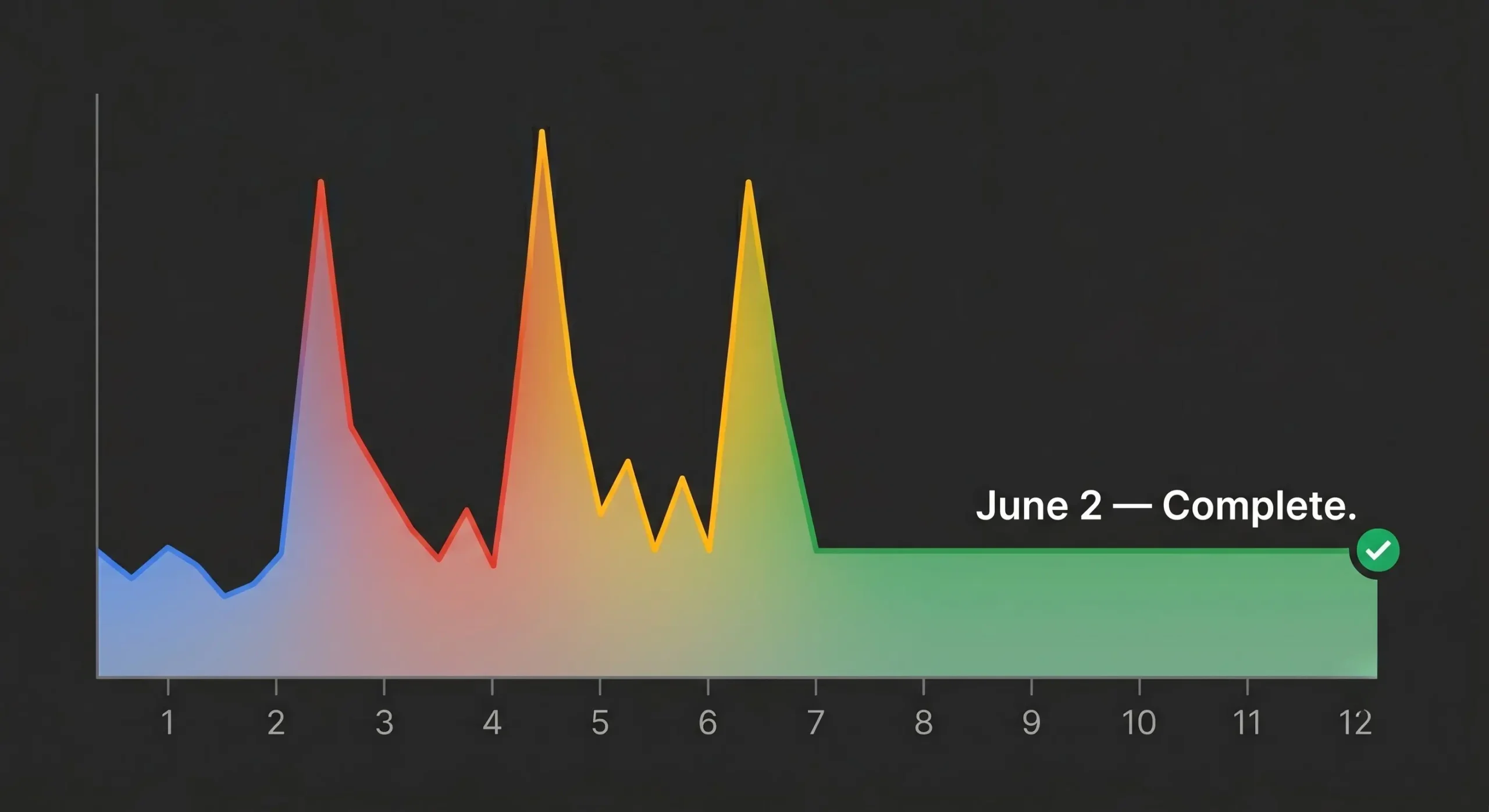
Google confirmed the completion of the May 2026 core update this morning, posting on X via the @googlesearchc account and updating the Search Status Dashboard to reflect the closed incident.[1] The announcement landed at 05:40 PDT — and in an unusual twist, tracking tools were recording a final burst of elevated volatility on June 2 itself right before Google called it done.
That timing is worth noting. The last hours of this rollout were among its most active. If your rankings moved overnight or shifted in the past 24 hours, that movement is part of the same update, not the start of something new. The algorithm has stopped processing. What you are seeing in your dashboards right now is the freshest signal you have had since May 21 — but it is not fully settled yet, and how you read it in the next few days matters a great deal.
I have been tracking this update since it launched eleven days ago and wrote about the early volatility patterns while it was still live. Now that it is officially complete, here is the full picture of what happened and the sequence of steps for reading your data without drawing the wrong conclusions too early.
What the Full Rollout Actually Looked Like
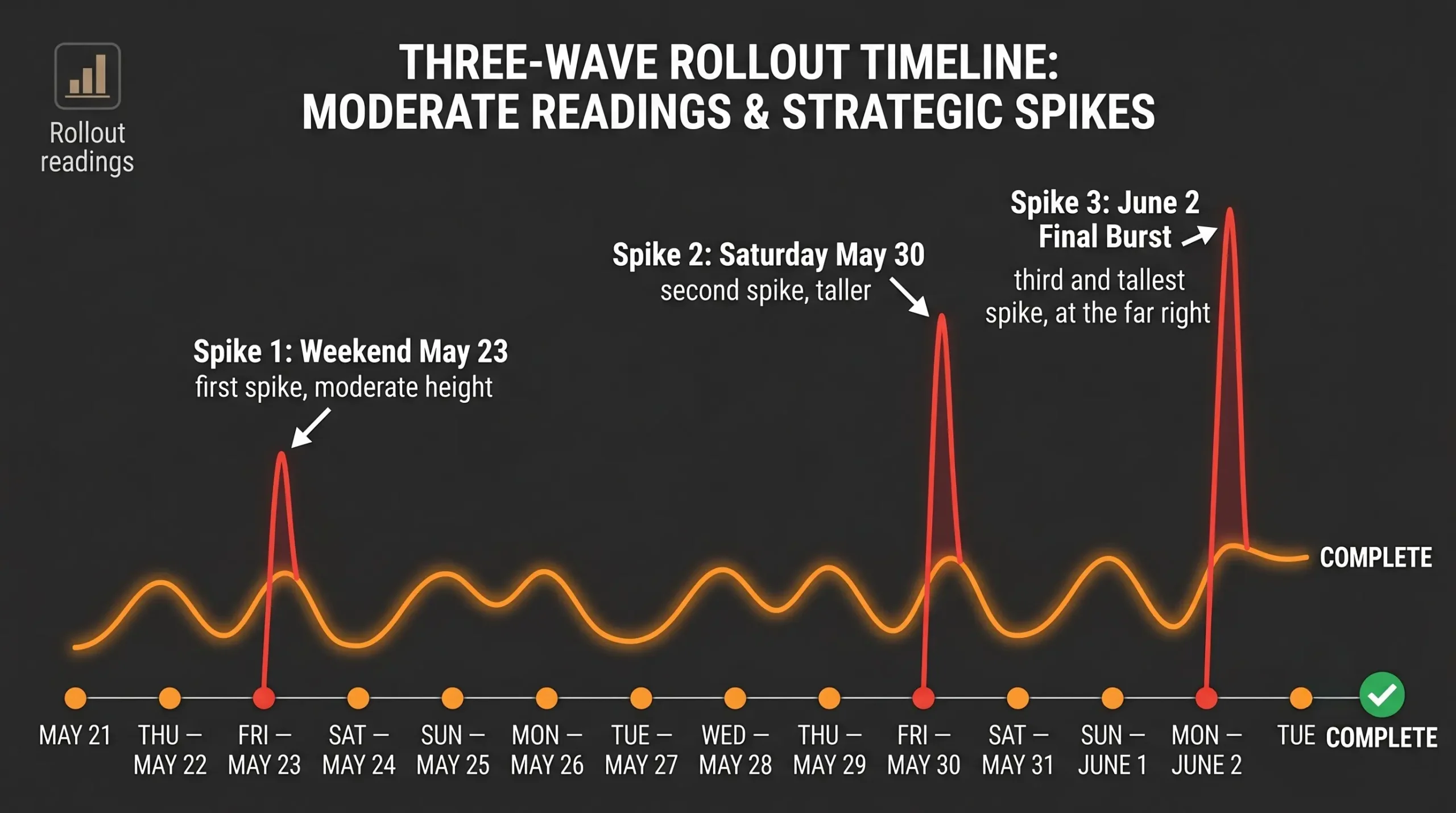
This was not a smooth rollout. Most core updates move in a rough arc: elevated activity early, then a gradual taper toward completion. May 2026 did not behave that way. It produced three separate periods of sharp volatility, each with its own character.
Where This Update Sits in Context
The practitioner consensus across the SEO community is consistent: May felt larger than March.[2] The March 2026 update was described by many as a "meh" release relative to expectations. May was not. Multiple independent practitioners reported that the impact was more pronounced and affected a broader range of site types than March.
That said, it is worth keeping perspective. This is a broad core update with no stated targets. Sites that gained visibility are not being rewarded for something specific. Sites that lost rankings are not being penalised for a named violation. Google re-scored content quality signals across its entire index, and the relative positions shifted accordingly. That is the mechanism. Understanding it clearly is what separates a useful post-update analysis from a reactive one.
The Analysis Sequence: How to Read Your Data Correctly

Google's guidance on post-update analysis has been consistent across every core update: there are no specific actions to take immediately, rankings may continue settling for some time after completion, and the biggest recovery movements typically follow a subsequent core update rather than arriving between them.[1] That does not mean you should ignore your data. It means you should read it carefully and not draw hard conclusions from the first few days of post-rollout numbers, which can still reflect residual volatility rather than the true settled state.
Step 1: Establish a clean baseline comparison
- Set your comparison window in Search Console to April 1 to May 20 versus post-June 2 data once it has had a few days to settle. This gives you pre-update data that is not contaminated by the February Discover update. Do not compare against April 8 to May 20 alone — the 43-day gap means some sites were still recovering from March during that window.[3]
- Segment by page type before reading anything. Mix informational content, service pages, and e-commerce pages into a single view and the aggregated signal will mislead you. Filter by URL path, query category, or page template first.[4]
- Separate traffic drops from ranking drops. Impressions down but CTR stable suggests a ranking change. Impressions stable but CTR down suggests a title or meta description issue. They have different causes and different responses. Reading blended traffic as a single number misses this distinction entirely.
Step 2: Identify the pattern, not the page
- Look for which type of pages moved, not just which pages moved. If your product category pages dropped but your brand pages held, the signal is about content depth on commercial pages. If your blog posts dropped but nothing else moved, the signal is about content quality on informational content. The pattern across page types is the diagnostic, not the individual URL.[5]
- Check which of your pages gained. A core update that costs you visibility in one area almost always gives it to someone. Finding out who outranked you and why is worth more than any self-assessment framework. The pages now above you are the clearest signal Google has given you about what it currently considers sufficient quality for that query.[4]
What to Act On and What to Leave Alone
Act on these once data settles
- Pages that dropped and, on honest assessment, do not demonstrate real expertise on the topic they target. The question is not whether the content is long or well-formatted. The question is whether it contains anything a genuine subject-matter expert would say that is not already available everywhere else. If the answer is no, that is your starting point for improvement. A proper SEO content audit on those pages will surface exactly what needs addressing.[5]
- Pages with thin or templated copy that are now outranked by pages with clearly richer, more specific content. Do not rewrite for length. Rewrite for specificity, first-hand detail, and genuine utility.
- Your generative engine optimisation strategy. Google's AI Overviews are now compressing organic traffic on informational queries. The question of how your content appears inside AI-generated answers is no longer optional strategy. Pages that gain citations inside AI Overviews are building a traffic channel that is becoming more important than the blue-link position beneath them.[1]
Leave these alone
- Pages that dropped during the rollout but have since partially recovered. The three-spike pattern means some of those drops were temporary mid-rollout fluctuations. Allow a few days for data to settle before deciding whether a drop is real or residual.[3]
- Your site architecture and internal linking structure. Do not restructure navigation or rebuild your internal link map in response to a single update's data. These changes take months to evaluate and are almost impossible to attribute cleanly to any one cause. If you were already planning a structural review, start with a content audit of your affected pages and build a prioritised action plan from the data before touching structure.
- Pages that held or gained visibility. Do not change what is working. This sounds obvious. It is surprisingly easy to over-optimise pages that came through a core update well in an attempt to push them further. The risk is higher than the likely reward.
The Bigger Picture: What May 2026 Tells Us About the Rest of the Year
Four major algorithm events in 2026 before June. A 43-day gap between March and May. A rollout that felt heavier than any update since 2024. The trajectory is clear: Google is moving faster, and the enforcement of content quality signals is becoming more consistent across every cycle.
At the same time, the context for organic search is genuinely changing. AI Overviews and AI Mode are compressing click-through rates on informational queries. The first position is becoming more valuable because fewer users scroll past the AI-generated answer block to reach it. That makes ranking in positions one through three significantly more important than it was 18 months ago, and it makes content that earns citations inside AI answers a meaningful parallel priority.[1]
If May 2026 affected your site, the path forward is the same it has been after every core update since 2022: genuine content quality improvements, real E-E-A-T signals, and a content strategy built around what your users actually need rather than what the algorithm used to reward. The execution of that strategy is where local SEO, link authority, and GEO all become part of the same conversation rather than separate workstreams.
- Search Engine Land. "Google May 2026 core update rollout is now complete." June 2, 2026. searchengineland.com
- Search Engine Roundtable / Schwartz, Barry. "Google May 2026 Broad Core Update Is Done Rolling Out." June 2, 2026. seroundtable.com
- Digital Applied. "Google May 2026 Core Update Done: Final-State Recovery Plan." June 2, 2026. digitalapplied.com
- SEO Kreativ. "Google May 2026 Core Update Complete: Facts and Analysis." June 2026. seo-kreativ.de
- Coalition Technologies. "May 2026 Google Core Algorithm Update." June 2, 2026. coalitiontechnologies.com
- Search Engine Journal. "Google's May Core Update Complete After Volatile Rollout." June 2026. searchenginejournal.com
- Stan Ventures. "Google Officially Completes the May 2026 Core Update Rollout." June 2026. stanventures.com
- Primo Tech. "Google's May 2026 Core Update Is Done: What Really Happened." June 2026. primotech.com