
Google Made It Official: llms.txt Files Do Nothing for Your Search Rankings
Google Made It Official: llms.txt Files Do Nothing for Your Search Rankings
On June 15, 2026, Google updated its official guide for optimising for generative AI search to settle a question the SEO community has been debating for months. The answer is in the documentation, in plain language, with no room for interpretation.
The llms.txt file proposal has been circulating in SEO and developer communities since 2024. The idea is straightforward: a plain text file at the root of your site that tells large language models what your site contains and how to navigate it. For a while, creating one was positioned as a forward-thinking move, a way to prepare your site for the AI-first search era before the standards were formalised.
Google has now removed that ambiguity in its official documentation. The update was published on June 15, 2026, as part of a broader clarification to the Search Central guide on optimising for generative AI features in Google Search.[1] Two specific additions were made to the mythbusting section of that guide. Both are worth reading exactly as written.
What Google Actually Added to the Documentation
The first addition is a standalone note under the llms.txt entry in the mythbusting section of the guide. It reads in full:
The second addition was a clarification of existing text in the same section. Google added the bolded portion to an existing line that previously covered AI text files and Markdown more broadly. The updated sentence now reads:
Google also explained why these additions were made. In the documentation changelog, the stated reason was to address questions from the community and clarify that while these files are not needed for Google Search and will not negatively or positively affect visibility or rankings, it is fine to maintain them for other services or systems that do use them.[1]
This Is Not a New Position. It Is a Formal One.
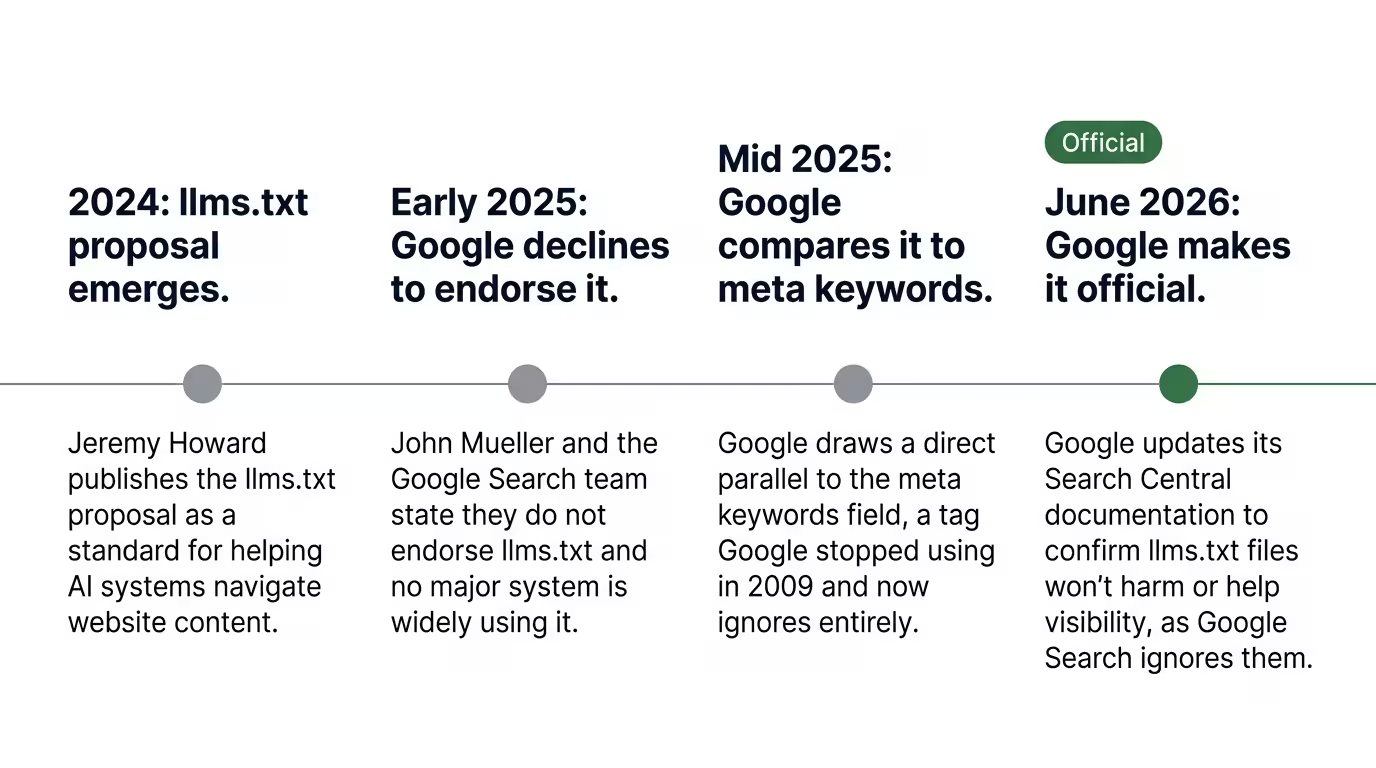
Google has been consistent on this point for over a year. What changed on June 15 is not the position itself but the formality with which it has been stated. The update takes what was previously scattered across various interviews, podcast episodes, and forum responses and puts it into the canonical developer documentation where it belongs.
Previously, Google had said it does not endorse llms.txt files. It had noted that no system was widely using them. A comparison was drawn to the meta keywords field, once thought to carry SEO weight, later confirmed to be entirely ignored by Google. Google had even suggested that noindexing llms.txt files was a reasonable approach if you had created one and wanted to prevent crawlers from spending budget on it.[2]
The comparison to meta keywords is the most useful historical parallel here. For years, the meta keywords tag was treated by some SEOs as a meaningful ranking signal. Google stopped using it in 2009. Sites that continued investing time in maintaining it lost nothing and gained nothing. The resource spent on it was simply wasted on a signal that was not being read. The llms.txt situation is structurally identical, with the difference that Google has clarified the position considerably faster this time.
What the Same Document Says Actually Works
The guide that received this update is not just a list of things to ignore. It is Google's full official position on how to optimise for generative AI search, and the positive guidance in it is worth reading alongside the mythbusting section. The document makes clear that SEO fundamentals remain the entire foundation of visibility in AI-powered search features.
The guide specifically calls out several things the SEO community has been told to prioritise for AI visibility, and addresses each one directly. Chunking content into smaller pieces for AI comprehension is listed as unnecessary, because Google's systems already understand nuance across full pages. Rewriting content in a specific style for AI is listed as unnecessary, because AI systems understand synonyms and general meanings without needing exact keyword matching. Seeking inauthentic mentions across the web for AI citation purposes is called out explicitly as ineffective and subject to spam policies.[1]
What the document describes as genuinely effective for both search and AI features follows a consistent pattern.
- Content that provides a unique point of view based on real experience, rather than summaries of what is already available everywhere else. Google's AI systems review multiple sources, and content that genuinely stands out is more likely to be surfaced and cited.[1]
- Non-commodity content that goes beyond common knowledge. The guide distinguishes between a generic list article that anyone could produce and content built on genuine expertise or first-hand experience. The latter is what AI features are designed to surface.[1]
- Clean technical structure: crawlable pages, proper semantic HTML, good page experience, no duplicate content. The guide is explicit that a page must be indexed and eligible to appear in Google Search in order to appear in generative AI features at all. The technical foundation is non-negotiable.[1]
- For local businesses and e-commerce, Google Business Profiles and Merchant Center feeds remain relevant as they can feed directly into AI-generated responses. These are the actual structured inputs that AI features use, not self-authored text files at the root of a domain.[1]
Should You Delete Your llms.txt If You Have One?
The update is clear that creating and maintaining an llms.txt file is completely fine if you are doing it for other services or systems that do use it. Some AI assistants and browser agents may read these files. The file itself is not harmful to your Google Search performance. The update is not a reason to delete one if it is already there and serving a purpose elsewhere.
What it is a reason to do is stop treating llms.txt as a Google Search optimisation task. If the resource being put into creating, updating, and managing an llms.txt file is being justified by expected improvements in Google Search visibility, that justification no longer holds. The documentation is unambiguous about this.
- Google Search Central. "Optimizing your website for generative AI features on Google Search." Updated June 15, 2026. developers.google.com
- Schwartz, Barry. "Google Says LLMS.txt Files Won't Help Or Hurt Your Search Rankings." Search Engine Roundtable, June 16, 2026. seroundtable.com
- Google Search Central. "Documentation updates: Clarifying guidance on llms.txt files." June 15, 2026. developers.google.com