

Google Just Launched the June 2026 Spam Update. Here Is What Is Actually Being Targeted.
Google Just Launched the June 2026 Spam Update. Here Is What Is Actually Being Targeted.
The update went live yesterday at 9:03 AM PDT. It is global, powered by SpamBrain, and Google confirmed it does not target link spam. Early signals from the first 24 hours are pointing directly at scaled and templated content. The rollout is still active as of this morning.
Yesterday at 9:00 AM PDT, Google logged a new incident on its Search Status Dashboard and posted the confirmation on LinkedIn shortly after. No blog post, no policy document, no detailed explanation. A single dashboard entry and two lines on LinkedIn is how Google handles a standard spam enforcement update, and that is all that came with this one.[1]
By yesterday evening, a dozen volatility tracking tools were showing sustained elevated readings. By this morning, the first 24 hours of community observation had produced enough consistent signals to start building a picture of what SpamBrain is actually going after. Here is what is confirmed and what is directional.
The Confirmed Facts First
What SpamBrain Is and Why It Matters Here
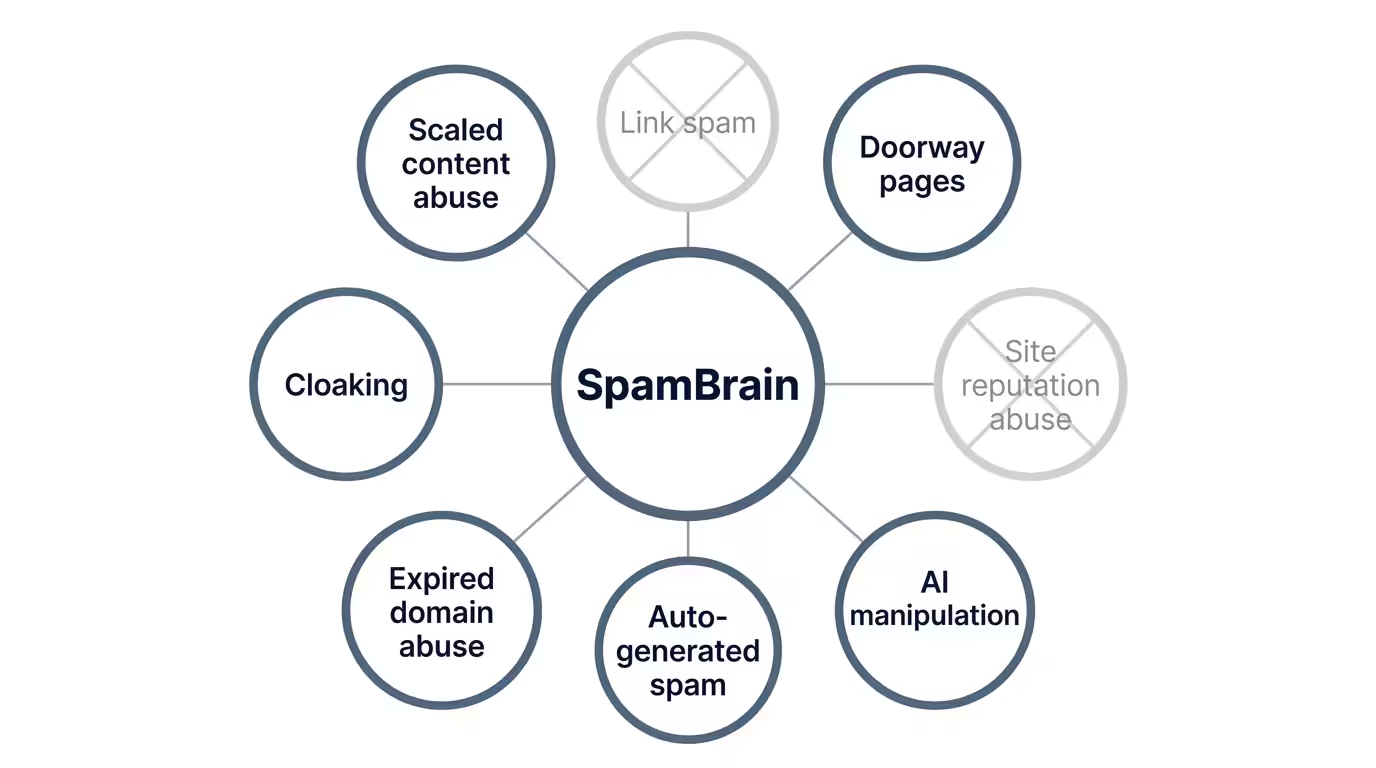
Every Google spam update runs through SpamBrain, its AI-based spam-prevention system that Google first deployed publicly at scale in December 2022. SpamBrain is not a rulebook. It is a trained classifier that gets periodically recalibrated to catch spam types it was already designed to detect, but more accurately, or to start catching patterns it was previously missing.[5]
When Google announces a spam update, it is not introducing new policies. It is announcing that SpamBrain received a meaningful parameter update. The policies being enforced are the existing ones. The detection just got sharper. That distinction matters for how you read your Search Console data: a spam penalty means your site is being flagged for something that was already against the rules, not something that became a rule yesterday.[2]
Google also updated its spam policies in May 2026 to formally include manipulating AI Overviews and AI Mode as a category of spam. While this June update makes no explicit reference to that policy change, the direction is consistent: scaled, low-value content built to rank rather than to serve users, including inside AI-generated answer systems, is increasingly in the enforcement frame.[3]
What the First 24 Hours Are Pointing At
Google has not named a specific content category as this update's focus. It rarely does. What it has confirmed is what this update is not targeting: link spam and the site reputation abuse policy are both explicitly excluded.[1] By elimination, that points enforcement toward the content and technical end of the spam policy spectrum.
Early observations from the first 24 hours of the rollout are consistent across multiple practitioners tracking large site portfolios. Templated location-page networks are showing the most movement. Sites running city-plus-service landing pages where two pages are structurally identical except for the town name are seeing the clearest ranking shifts. This is the exact content profile that SpamBrain has been built to classify as scaled content abuse.[3]
How This Sits in the 2026 Update Calendar
Four major algorithm events in roughly 13 weeks. The pace of enforcement in 2026 is faster than in any comparable period in recent years, and it reflects a clear direction: content built to manipulate rankings rather than serve users is being targeted with increasing frequency and precision.[3]
It is also worth noting the context this update lands in. The May 2026 core update completed on June 2, just 22 days ago. Sites that are still recovering from that cycle may find it difficult to cleanly separate which change caused which movement in their SEO performance data. Annotating June 24 in Search Console is the only way to isolate this update's specific effect from the residual noise still settling from May.
What to Do Right Now
If you are monitoring but not affected
- Annotate June 24 in Google Search Console immediately if you have not already. This date marker isolates the spam update window from any subsequent changes and makes the data cleanly readable once the rollout completes.[6]
- Watch but do not act during the live rollout. Rankings are still moving. Any data you collect before the rollout completes is directional at best and actively misleading at worst. Clean post-rollout data is the right starting point for any decision.[4]
- If your local SEO strategy includes templated location pages where the content is structurally identical across cities, audit those pages now while the rollout is active, even if you have not seen movement yet. This is the profile that early signals are pointing at most consistently.
If your rankings or traffic have already moved
- Do not make structural changes mid-rollout. This applies to spam updates exactly as it does to core updates. Acting on volatile mid-rollout data risks compounding a problem that may not have fully resolved yet.[4]
- Do not delete or noindex pages based on this week's numbers alone. Verify the movement is real and sustained once the rollout window closes. A temporary dip during an active rollout is not the same as a settled penalty.[6]
- If you confirm a spam penalty after the rollout, review Google's published spam policies directly and audit your site against them honestly. Recovery from a spam penalty requires genuine compliance, not surface-level fixes. Google has confirmed this process can take many months.[1]
- If you have templated city or service pages, the practical response is not deletion. It is consolidation or genuine differentiation. Either make each page uniquely useful to someone in that specific location, or consolidate near-duplicate pages into one strong page with a proper redirect. A smaller set of genuinely useful pages outranks a large set of spun ones every time.[3]
The Bigger Pattern Worth Reading
The March 2026 spam update completed in under 24 hours, making it the fastest spam rollout on record. The June update is expected to take a few days. Rollout length does not predict severity. What both updates share is the same underlying logic: SpamBrain is getting incrementally better at detecting the gap between content that exists to rank and content that exists to help someone.[5]
The sites that are consistently coming through both spam and core updates without disruption share one characteristic. Their content does something for the reader that could not be replicated by swapping one keyword for another. That is not a philosophical position. It is what Google's spam systems are specifically trained to distinguish. The enforcement is getting faster and more precise with every cycle, and the gap between compliant content and policy-violating content is getting harder to straddle.[3]
- Schwartz, Barry. "Google June 2026 Spam Update Has Been Released." Search Engine Roundtable, June 24, 2026. seroundtable.com
- Search Engine Land. "Google releases June 2026 spam update." June 24, 2026. searchengineland.com
- Digital Nomads HQ. "Google's June 2026 spam update is live: what it hits and why it matters." June 2026. digitalnomadshq.com.au
- Coalition Technologies. "Google June 2026 Spam Update." June 2026. coalitiontechnologies.com
- Google Search Central. "Search spam updates." developers.google.com
- Launchcodex. "Google's June 2026 spam update: What to do now." June 2026. launchcodex.com
- Stan Ventures. "Google Just Launched The June 2026 Spam Update: Here's What It Means For Agencies." June 2026. stanventures.com
- Google Search Status Dashboard. June 2026 spam update incident. status.search.google.com