
The AI Boomerang Is Here. Companies Are Quietly Rehiring the People They Fired.
The AI Boomerang Is Here. Companies Are Quietly Rehiring the People They Fired.
The AI revolution promised lower costs and higher efficiency. Instead it delivered a compute bill that rivals payroll, a customer service collapse, and a very quiet round of job postings for positions that were eliminated six months ago.
In 2025, companies across tech, fintech, retail, and fast food placed a collective bet: that AI could handle the repetitive, process-driven work making up a large portion of their payroll. The pitch was straightforward. Lower costs, faster output, scalable capacity. Thousands of roles were cut. Press releases were issued. Investors approved.
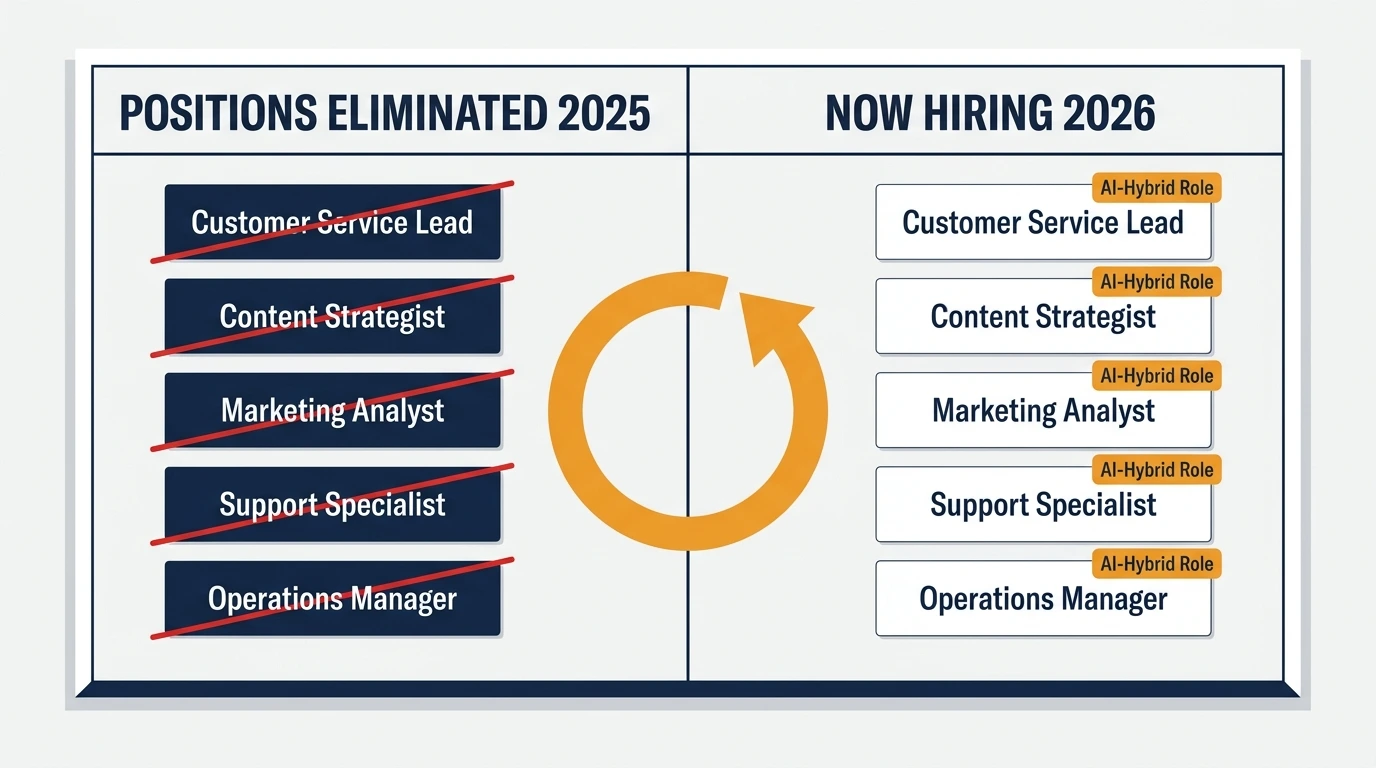
By mid-2026, a significant portion of those same companies are posting job openings for roles that look remarkably similar to the ones they eliminated. The job titles are slightly different. The salary requirements are notably higher. Nobody is issuing a press release about it.
This is the AI boomerang. Before drawing conclusions in either direction, the primary data is worth reading carefully, because several of the most widely shared statistics on this topic are being misattributed or overstated.
What the Primary Data Actually Says
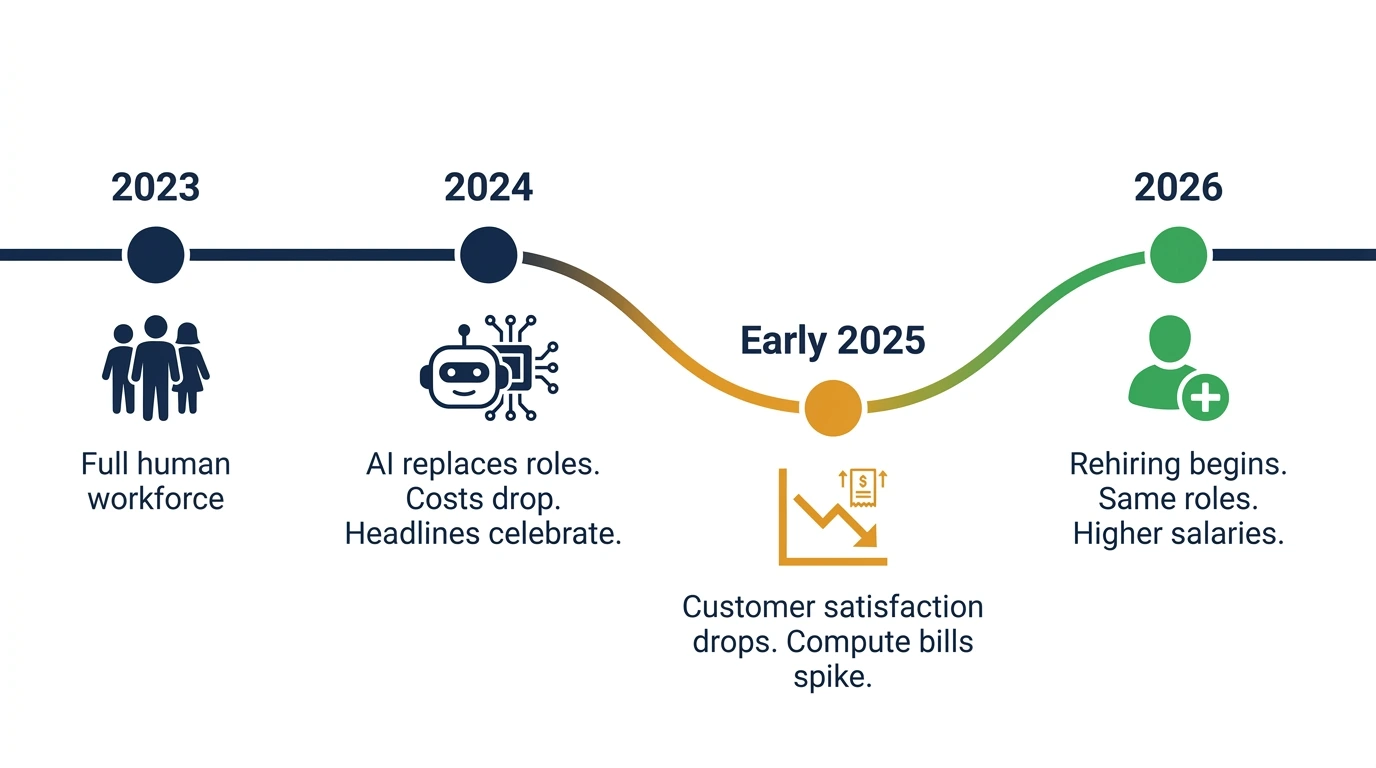
The most important primary source is Gartner's February 2026 forecast. By 2027, 50% of companies that attributed headcount reduction to AI will rehire staff to perform similar functions, but under different job titles, according to Gartner. Kathy Ross, Senior Director Analyst at Gartner, noted that most recent workforce reductions were influenced by broader economic conditions rather than automation alone, and that as organisations encounter the limits of AI and rising customer expectations, they will need to reinvest in human talent.[1]
One number in this Gartner data is frequently overlooked but critical for context: only 20% of customer service leaders have actually reduced agent staffing due to AI. The majority report that headcount remains steady, even as they support more customers.[1] The AI layoff narrative is real, but considerably more concentrated than the headlines suggest.
The second major source is Orgvue's April 2025 survey of 1,163 C-suite and senior business leaders. 39% of business leaders made employees redundant as a result of deploying AI. Of those, 55% admit they made wrong decisions about those redundancies.[2] This is an important distinction from how the stat is often reported. It is not that 55% of all executives regret replacing workers with AI. It is 55% of the 39% who actually made AI-driven redundancies, a meaningful difference.
The Hidden Cost Nobody Budgeted For
The core assumption that made AI workforce replacement attractive on a spreadsheet was that swapping a human salary for an AI licence would produce immediate savings. What companies found instead was a cost structure that looks nothing like that model.
Arvind Jain, CEO of Glean, a firm that provides businesses with AI and cloud computing support, told CNBC that the situation is unprecedented. "This is the first time ever that I can remember that technology costs the same as people," he said.[3] Bryan Catanzaro, Nvidia's Vice President of Applied Deep Learning, told Axios that the cost of computing is far beyond the costs of the employees on his team.[4]
Part of what drove costs so high is the pricing shift by major AI providers. Companies including Anthropic and OpenAI initially lured firms with flat-rate fees and monthly subscriptions, then pivoted to pay-as-you-go models calculated in tokens. At enterprise scale, those tokens add up to figures that rival and in some cases exceed human payroll costs.[3]
Goldman Sachs research published in May 2026 found that human call-centre agents could cost less than AI counterparts when total operational costs are factored in, a finding that directly challenged the financial logic of the original cuts.[5] The rehiring of displaced talent is also now carrying a 20 to 35 percent salary premium because these roles require people who can manage, audit, and prompt AI tools in addition to performing the original function.[6]
Who Is Actually Rehiring
What This Means for Digital Marketing Specifically
The departments most frequently cut in 2025 were content, social media, customer service, and digital marketing operations, precisely the functions where AI tools appeared most capable of substituting human output at lower cost.
What the data reveals is that AI performs well on the process layer of these functions: generating volume, scheduling posts, producing first drafts, running bid logic. It consistently underperforms on judgment, brand voice consistency, relationship quality, and crisis response. Those are not edge cases. They are the functions where marketing either builds or damages a brand.
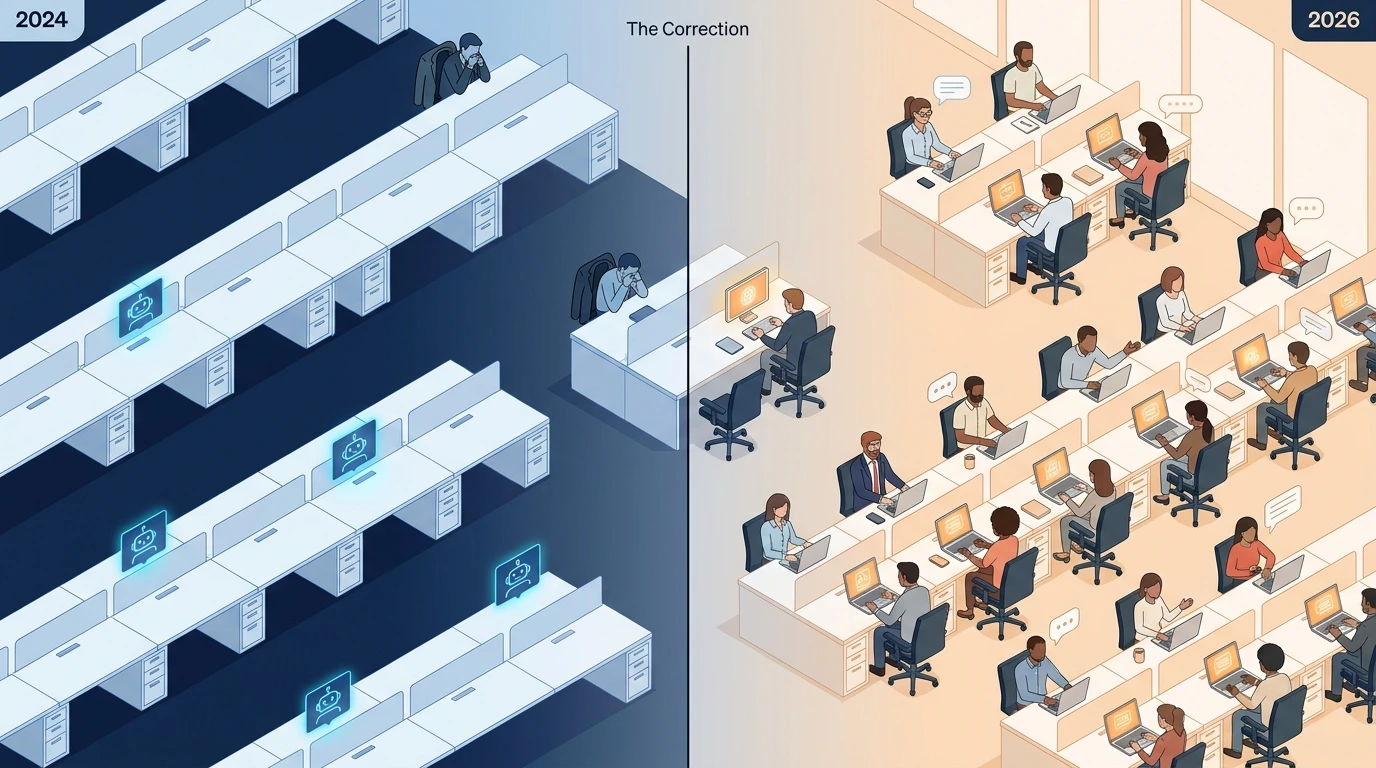
The companies now restaffing are not abandoning AI. They are rebuilding the human layer around it. The roles returning are hybrid positions: people who understand AI tools, can prompt and audit them effectively, and can apply the judgment that AI cannot supply. Those roles command a 20 to 35 percent salary premium over the positions they replaced.[6]
What to Take From This
- Do not replace judgment functions with AI. The consistent failure point across every boomerang case is the same: companies replaced roles requiring nuance, relationship management, or quality oversight with tools that perform those functions poorly. AI works as an accelerator of human judgment, not a substitute for it.
- Model the full cost before making cuts. The compute costs at scale, token-based pricing at volume, customer churn from quality drops, and the salary premium on rehiring all belong in the calculation. A salary line alone is not the full picture.[3]
- The IKEA model is the right frame. Automate the repeatable process layer, redeploy human capacity to the judgment layer, and build AI literacy into your existing team rather than replacing them. The companies now scrambling to rehire skipped that step and are paying a 20 to 35 percent premium to undo it.
- If you use AI in your SEO or content operations, the question is not whether to use it. The question is whether there is a human judgment layer directing, auditing, and refining its output. The companies that ran into trouble removed that layer entirely.
- Build AI fluency in your team now. The hybrid roles being created as companies restaff require people who understand AI tools and can apply judgment to their output. Growing that capability internally is considerably cheaper than competing for it at a 20 to 35 percent premium externally later.[6]
- Gartner. "Gartner Predicts Half of Companies That Cut Customer Service Staff Due to AI Will Rehire by 2027." February 3, 2026. gartner.com
- Orgvue. "55% of businesses admit wrong decisions in making employees redundant when bringing AI into the workforce." April 29, 2025. orgvue.com
- Boast, Laura. "Humans suddenly look better than AI when it comes to company costs." Moneywise, June 8, 2026. moneywise.com
- Catanzaro, Bryan (Nvidia VP). As cited in Axios, April 26, 2026. axios.com
- Goldman Sachs. "AI Agents Forecast to Boost Tech Cash Flow as Usage Soars." May 2026. goldmansachs.com
- Emerald Book. "The Great AI Boomerang: Google, Meta, Klarna and More Are Quietly Rehiring the Workers They Fired." May 31, 2026. emeraldbook.org
- Cybernews. "Microsoft engineers burned through entire 2026 AI budget on Claude Code." 2026. cybernews.com